Monday, July 11, 2011

Last Days in Fiji

The west side of Fiji is beautiful. We grabbed a mooring ball in port Denerau and scheduled to haul out Broken Compass (This is the first time we have taken her out of the water since purchasing her). As waves of tourists and honeymooners passed through the marina in transit to the outer islands, we shifted to work mode. The bottom was caked with a half-inch layer of algae and barnacles... No wonder we have been sailing slow. Our rudder had her own issues. Unbeknownst to us, she was harboring a worm, who had eaten its way through the wood. With a piece of wire, we traced and ended the path of the worm. The list of repairs grew with every nut inspected. BC turned into a chemistry lab with mixtures of epoxy, paint, hardeners, thinners, cleaners and resin. Potential hazards and breakdowns were eliminated one by one until Broken Compass splashed 2 weeks later with a new colors.


Joining the ranks of cruising yachts, we motor/sailed to Musket Cove. They call Musket Cove “The vortex” due to the world class surf and island comforts that can trap sailors for years. We hooked up with our friend Mark, captain of Northfork, and hit the reefs. Spending over a year in the islands, dinner by spear was like picking from the menu of a seafood restaurant. After a couple days we sailed to Lautoka, pulling ourselves from our friends and the vortex. All aspects of our sea trial seemed perfect until the new clutch on our recently rebuilt starter made a grinding noise and snapped. Replaced once again and Fiji astern, we are off for Bali. Estimated trip time is 36 days crossing the Coral Sea, Torres Strait, Arafura Sea, and Timor Sea.


Pray for wind!

Thursday, June 30, 2011

Sail to Nadi


Continuing to rely solely on the wind, all of our sails take longer than expected. The first few hours down the southern coast were pleasant with following wind and seas. We decided to take a short cut through Beqa passage close to where we went shark diving the previous month. Short cuts typically increase risk. Well, the wind switched then died, leaving us in the middle of the passage. It returned heavy on the nose with rain. Due to our limited navigation equipment coupled with Fiji's reputation for shipwrecks, it was a little unsettling sailing along the coast on a moonless night. The abundance of reef patches and strong currents running through the passage gave the night some flavor.

The next evening we hooked into a tuna. We were a little out of practice. I saw the rod bend and per procedure, screamed, “Fish!!!” Chad flew on deck from a nap, realized it was dark, and bombed down below to retrieve a headlamp. I had left the helm to work the fish and the boat self tacked back over the line, causing it to tangle under the boat. Rigging, sails, solar panels, Firefox, and Makai all posed unique challenges to the procurement of this fish. I pulled it alongside before we remembered our gaffe deficiency. No problem, wire leader... just haul it up when the boat heels over. One... two... wait... three! The fish came aboard surprisingly well with the motion of the boat. A little too well. I stepped aside to watch Chad trip over the cooler while bear hugging a 45 pound yellow fin tuna. As they landed, one of the treble hooks caught Chad's calf, further connecting him to the fish.

I dove below to the tool box and after two unsuccessful attempts with wire cutters and pliers, grabbed the bolt cutters. In all my life, I have never seen a landed fish so calm. Chad sat quietly with him, knowing a crazed tuna would cause a few deep lacerations in his leg. The bolt cutters worked just before the fish began his final flipping fit.

The next morning we positioned ourselves to sail upwind through Navula Passage. We were sailing confidently through with plenty of wind, then a loud cracking noise followed by a splash. The jib sail along with the entire forestay/roller furling system ripped out of the mast and fell in the water. We lashed the sail and hardware alongside as we limped on the mizzen and a double reefed main. Threading breaking waves on either side of the pass added to the excitement. We anchored for the evening in Momi Bay to assess the damage in and devour some yellow fin. The next day, with fairer winds, we continued up to Port Denarau to haul the boat out of the water for some much needed repairs.

Suva

It took us three (more) long weeks to realize Suva is the unlucky side of Fiji. It rained almost every day we were anchored, and if something on the boat wasn't broken, it happened there. Our outboard engine took another 2 week vacation after the starter coil burned out.

The toilet joined the outboard, leaving us scrambling to find specialized parts.

Our engine led us through the fuel system to the injectors to the timing back to the injectors to end ironically with the clutch of our brand new starter breaking due to a manufacturing defect. We discovered sending a new starter to Fiji is equivalent to purchasing a round trip ticket. We were left searching truck graveyards of Fiji.

Breakdowns are not uncommon in Suva. One not need look far to see wrecks and remains of boats around the harbor. The frequent sinking of boats and close calls discussed over Fiji Bitters at the Royal Suva Yacht Club were a strong omen to leave. One of our friends, Troutbridge, hit the reef coming in the Suva harbor. His boat was stuck on the reef for over two weeks. We departed shortly thereafter.

All mishaps aside, Suva is a fun city. The people stop you in the street just to talk to you, and there are a lot of great bars and clubs. We made many friends quickly and enjoyed the simplicity of the Fijian lifestyle. We were picked up by a couple cute Fijian girls at a bar and found ourselves playing squash at the university and learning local agricultural techniques for fish and prawn farming. Tired of the rain, we picked up the anchor to head over to the Western side for some sun.

Monday, June 27, 2011

Fiji

The trip to Fiji provided a nice variety of wind, squalls and calm sunny days. We had a full crew including Mike Foley and our little Brother, Tyler. The absence of consistent wind delt a delayed arrival to Fiji unfortunately missing Tyler's flight back to LA. We landed in Suva, the capital of Fiji. The capital is not like the brochures. There are no beaches, blue water or tourists. We spent a couple days at the Royal Suva Yacht club fixing the Tahatsu from her swim a couple weeks prior. We searched for a better location to entertain Liz and Ann Marie who would fly in to meet us in a couple days. Pacific Harbor became an immediate appeal when it advertised the "Adventure Capital of Fiji." We do not typically find ourselves allured by guided tours, however Pacific Harbor became an exception. We geared up in scuba equipment and decended to 70 feet underwater where trained professionals fed giant sharks. The sharks and pelagic fish were incredible. The fish comprised of tuna, trevally, and red snapper frenzy over fish carcass scraps. The sharks on the other hand, are more coy. The larger sharks move slowly with grace and power, like kings of the ocean. They carefully selected their meals and inhaled tuna heads in a single bite. During the dive we saw up to 12 foot bull and lemon sharks. It was an unforgettable experience.

We took a side trip to an isolated beach where Makai could release some energy. Similar to the other islands we attempted sneak her to remote places. This plan never works. Taking Makai to land is like to taking Nemo through an elementary school. Exotic creatures never go unnoticed. She found her peer group quickly and ran around with the kids of a local police officer named Osea. Osea, like many other Fijians, looks and holds himself like a warrior. His interrogation was inquisitive more than threatening and we enjoyed lunch with his family. We quickly became good friends and spent the following day, sitting in a circle eating and drinking kava for hours.

After a couple days in Pacific Harbor we sailed to an island called Beqa. Beqa is known for walking on fire and their supernatural ability to heal burn wounds by touch. It is customary to take Kava to the chief for permission to stay in the village. Although we would sleep in the boat, Kava opens doors. After presenting the Kava, the village decided to throw Mike a birthday party. Mike's Birthday started early with wake boarding under the stars at 3am. Sleep was optional and we all joined the village at a nearby beach for game day. The men provided lunch via spear. The women thatched and made the fire. The kids played and climbed coconut trees. We were encouraged to join the kids and happily obliged, drowning ourselves in coconut water.

The sail back to Suva was difficult with no wind or head winds. Firefox took a detour half way to obtain extra petrol in order to connect Mike with his departure flight. In Suva the plan is to outfit Broken Compass for a successful 40 day trek over to Bali.

Wednesday, May 4, 2011

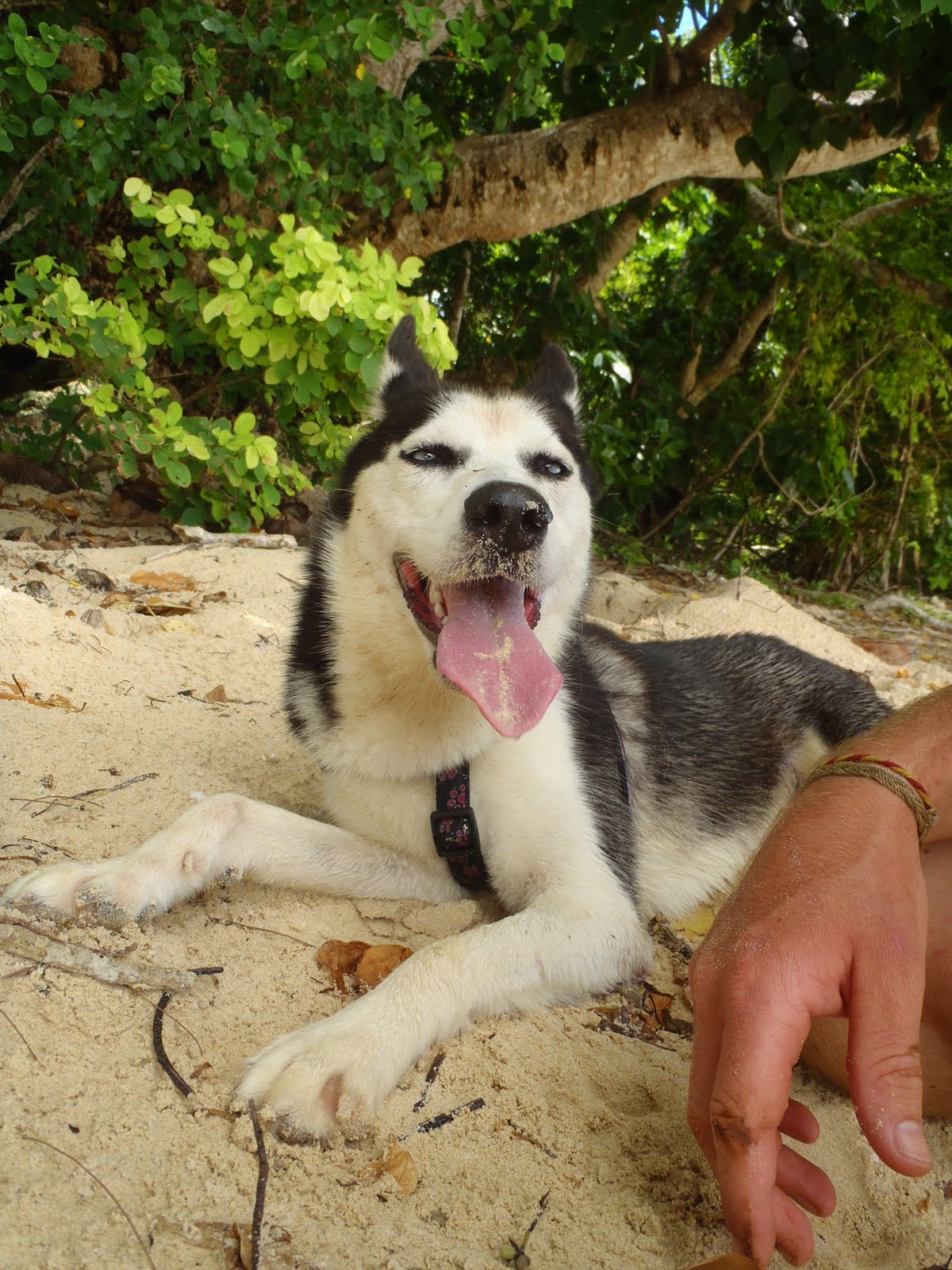
Snow Dog in Tonga

We landed on another island. All these islands look the same in the south pacific. I was just happy to see land. Tonga is a little different. Christian missionaries abolished cannibalism among people but there were never missionaries for dogs. In Tonga, people eat dog and dogs eat everything. Tonga is one dangerous place! I have heard a couple jokes about being thrown in the umu (an underground oven) but no one made a move on me. The boys scored us a sweet island gig. I can now run, roam, swim, and sleep on the beach all I want. I have an island all to myself… well, almost all to myself.

Honyo. Honyo is a Tongan dog on the island. After miles at sea and always on the move, I was happy to have a friend to play with and settle down. She had other plans and was not very welcoming. Some days we could run and play together, but when dinner time arrived tempers stirred. We exchanged in a couple of scuffles, which were always quickly ended by the boys. Some fights went better than others. Although we did not end best friends, Honyo taught me a one valuable lesson: Never turn your back on a hungry dog.

Aside from the complicated relationship with the Honyo, we have had a couple adventures. An average day involves exploration and the procurement food. This includes wild coconuts, bread fruit and fish. The boys caught sardines in nets and went underwater for the bigger ones. I always worry a little when they disappear under the water and am equally excited when they return to the surface. One day we tried something new. The boys took me out to go pig hunting with a bow and arrow. I have no idea how to hunt pigs! We made it about 50 human paces into the forest when I heard a noise. I chased it listening to my wolf instincts and ignoring the boys' request to return. I found the source to be a wild chicken. This I can handle. I caught it and brought it home so the boys could cook it up. At least one of us caught dinner and it was delicious.

Thursday, April 28, 2011

For want of a Snapper

Fishing has become a large part of our daily activity in the past year and a half. On Eueiki island, we spear our food almost every evening. This evening we wanted a particular fish: the red snapper. These have been most difficult to shoot, as they are the predators preying on reef fish that wander into deeper water. We divided our strategy with Chad and Allistair fishing and myself and Tyler spearfishing. The ocean was rough that evening by our standards (we later found out it was the result of a cyclone a few hundred miles away). I considered the lee shore of the island, but Chad reminded me the snapper were more abundant on the south reef of Euakafa, the island two miles to the west. When there are fish, safety slips from the mind like the hazy memory of a budget after a few drinks at the bar.


Tyler and I donned our gear, and hopped off the dinghy (Firefox). After a few dives, Tyler surfaced with a small chub. Chad and Allistair stayed away from the reef in white-capped open water. Calming myself in the excited water, I took a deep breath and performed a quick duck dive. Descending to fifty feet I clutched a piece of dead coral to stabilize myself against the strong current. Five red snapper swam in my direction and stopped. After what seemed like a debate to continue, the brave one entered my range and I squeezed the trigger. The spear pierced through both gill plates and I surfaced calling for Chad to pull around the boat.


Conditions seemed to have worsened during the below water time. Chad approached and a wave pushed the boat over me. Thankfully, Chad had put the engine in neutral, preventing the propeller from blending my left abdomen. This act unfortunately caused the engine to stall as it drifted swiftly towards the reef. In between swells I saw a six foot breaking wave lift the back of Firefox and throw Chad and Allistair into the air. Paddles, fishing rods, fish, a bucket, masks, snorkels, and spear guns scattered across the ten foot deep reef as waves continued to crash over the boat. I quickly tied the fish (still in my hands attached to the gun) to a large piece of coral underwater. After a difficult time righting the boat Tyler and I became rescue divers scouring the reef for lost equipment an amazingly recovering all except for the paddles and a bucket.


Having been submerged, the engine became non-functioning. Tyler, Chad and I swam Firefox against the wind, waves, and current to a relatively sheltered area on the outside of the reef and weighed our options. The sun was down and the decision to stay anchored through the night quickly became our best option. The largest concern was our Mother and Mike still being on the island and not knowing our location or situation.


It was a long, cold, sleepless night out with 4 people crammed in a 14 foot inflatable boat. Every ten minutes a wave would crash over the bow drenching our shirtless bodies. When the frequent squalls blew through, we developed a shelter system with four fins acting as shields. We shot a spear out as a secondary anchor in the event our primary failed (fortunately it did not).


Early the next morning, Chad and Tyler put on our squall shields and swam the mile and a half to Eueiki across “Shark Alley,” known for having large sharks. Walking up the beach, then casually greeted Mike and our Mom. The time was around 6:30AM, right before a meeting took place in the main town to coordinate a search and rescue party. Some local friends came out to tow our boat back to the island through rough seas. After the rescue, Captain Ongo, a speaking chief and owner of the uninhabited island we spent the night off of just smiled as he watched me unload the last item on our boat. In my hands I held a 10 pound red snapper.

Taste of Tonga

Our good friend Mike Foley just left the Broken Compass after visiting for over a month. When we have friends visit we make very few promises, except that their time on the boat will be “an experience.”


(Mike's first fish by spear)


One of the first nights on the island a dog fight broke out. Chad and I flew from the dinner table to break it as he grabbed Makai, and myself onto the island dog, Honyo. Teeth were in a shark like frenzy when I grabbed Honyo's cheeks to pull her off. I held Honyo from clamping down on Makai's neck, which freed Makai to take another bite at Honyo. Makai's white fangs disappeared into my wrist and slid out effortlessly. The fight stopped immediately and I slowly walked back to the kitchen to receive “Island doctoring” which consists of a medicine tree and Chad's suturing.


Life on the island settled down a bit and we watched a movie and went to bed early one night. Chad moved out to the dock. The dock is an ideal spot on hot nights with the cooling ocean breeze. Taking in the thousands of stars overhead keep you up for a few minutes, until the gentle sounds of waves on the coral beach induces sleep. Little did we know, halfway across the pacific the devastating tsunami hit Japan. A Tongan friend named Sione motored his little outboard boat 5 miles that night to warn us of the coming wave. We quickly gathered a few belongings, expecting the island to be submerged in the next couple hours. We sailed the remaining hours in the dark to a safer harbor, only able to hope for the best. Luckily, only a few boats in Tonga were damaged from abnormal tidal surges, marked by bouys to the harbor being torn out of the ground.


The following day we were invited by a Tongan friend to celebrate the harvesting of yams. We headed off to the rough village of Pangi. Removing yams from the earth is not an easy task. A spade is used to clear an area around the yam, which is vertically buried up to 4 feet deep. Each foot long yam took us about 20 minutes, while the larger expensive yams were reserved for the most experienced farmers. The afternoon was rounded with a beach party where we watched the water level rise and fall as a result of earthquake aftershocks.


Back to the village to finish the yam harvesting festival, we ate fish and yams. Kava, a drink mixture from a local root followed dinner. Accepting an invitation to sleep in the village, we were all sardined into position, and with my feet inches from the father's face. The following morning our surrogate mother dressed us in traditional church clothes in my first church attendance since arriving in the Pacific. The invitation continued into the afternoon as we ate pig along with more yams and a taro leaf dish. We lazily lounged on Ano beach after the feast, absorbing the sun and swatting at mosquitoes.