
We have developed a reputation for cruising the pacific under sail without assistance, and Pago Pago (hopefully) was our final challenge. Our entrance into the harbor was text book. The lee shore anchorage boasted 25 knots of breeze, intermittent squalls and poor holding. We rounded a moored fishing trawler gracefully maneuvering the boat upwind to deploy the anchor. Anchor down and sails under control, we drifted back to set the anchor. Executed beautifully, there was only one catch (or lack thereof): the boat kept drifting.
We re-engaged the jib, sailing on a backwards drift and tactfully dodged 3 other boats. 230 ft of chain on anchor #1 and 180ft of chain/1" nylon rode on anchor #2 finally settled us into 20 feet of water as the hook caught an unmarked mooring line. We ended up dragging ¾ of the way across the anchorage. All of the other sailors are still unsure of whether the Broken Compass is crewed by luck or skill (sometimes we are not quite sure ourselves). Whichever the case, they presented us with a coconut award for surviving yet again. The boat is now berthed safely in the Pago Pago marina as shown:
Pago Pago harbor is in American Samoa, which is a territory of United States. What this means is they have the same government set-up and congressional representation (although they do not vote in Washington DC). The government here is extremely corrupt. They receive over $300 million annually in subsidies from the US government which is disappears amongst the various organizations. The island is far from paradise. Besides offshore tuna, reef, and the occational friendly turtle, American Samoa traded clear water and marine life for industry and plastic. Trash and pollution are just a way of life.

The NFL linebacker breeding ground reputation has been confirmed: they are HUGE! The people here have coined a phrase, "Eat like a Samoan." McDonalds even packs on extra beef patties to the double quarter pounder because supersizing is not enough. Corruption, pollution and size aside; Samoans are generally a carefree and welcoming people.
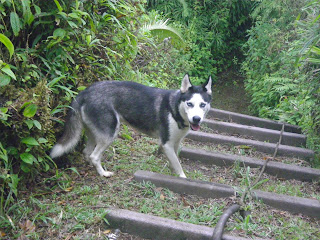
The 11 mile island offers mountainous terrain surrounded by coral reefs. There are a few good hikes which we explored in the first two weeks. Makai particularly enjoys chasing mice, geckos and the invasive king toads on the shaded paths. The majority of the land is privately held by villages which limits exploration of the island. We were deterred from one path by two men with shotguns who not so politely informed us we were trespassing.
We have spent a lot of time mingling and saying farewell to friends we accumulated throughout the pacific. Our main project here is to fix the engine which hasn't worked for 8 months now. Bret is flying to Mexico for a cousin's wedding. He will continue to Pennsylvania to visit family and friends. I will work on the boat with Makai to overhaul our rusted diesel engine (wish me luck!).


 They were placed 6 months prior for a 9 month contract to survive, prevent poaching, and collect dues from visiting yachts. They take people out spearfishing and organize potlucks for all of the visiting yachts.
  At least the hunters were able to eat an incredible meal...
  Apii taught many survival skills and we taught him a little something about spearfishing. He knew the same man, Fernando Faura whom we had spent three weeks with in Manihi (nearly 1500 miles away) learning how to spearfish. In Fernando's prime, he was one of the best divers and spearfisherman renowned throughout French Polynesia. Life in Suwarrow is simple but rewarding. With a friend from a boat called Nikita, we established a bridge club on the island to pass by squally afternoons. We went spearfishing when we needed food. Similar to a seafood menu, we had our choice of any fish we cared for but never took more than we could eat.
  The visibily of the water ranged from 60-100 feet and we reached new depths diving. The only threat were the sharks who always attacked the opportunity for a free meal or wounded fish on a spear. Sharks including white and black tip reef sharks along with greys generally ranging from 3-6 feet long. I counted 12 sharks surrounding our boat one afternoon after catching a trevally on rod and reel.
  Afternoons and evenings were typically spend trading stories and thoughts about sailing and life. One evening while planning a potluck, Apii decided we should go for lobster on the other side of the reef (4 miles away). We had to time the tide correctly, so the best time to hunt would be midnight. We set up camp including a tarp to sleep on and a pot spread on two rocks over a firepit. We watched the stars under a clear sky and waited until the tide went out, leaving the boat up on the rocks. We hunted tide pools armed with headlights, gloves and one machette. The gloves were for the spiny lobster and the machette was used for fish sleeping in the pools. Our take for the night was 25 lobster (3 nearly 2 feet long), 4 parrotfish, 3 grouper, 3 squirel fish, and 1 red snapper. We cooked 5 lobster for the two of us back at the campsite at 2am and contributed the remaining take for a party the following night. Suwarrow is a magical island, but one can't stay in paradise forever. We are off to give Broken Compass a little love in Pago Pago, American Samoa and see if she can ride out the cyclone season.
 The main island has two peaks with the largest called Mt. Otemanu reaching 727 meters or 2,399 feet . There are dozens of smaller islands called Motu's scattered within the circular reef surrounding Bora Bora. The clear blue lagoon is calm with several resort vacation bungaloos clustered along the coastline.
  Tourism is the main source of revenue for the island and the locals are not as easily approachable as in other places in French Polynesia. As a result, we have spent a majority of our time socializing with other cruisers. We celebrated our joint birthday by snorkling, spearfishing, and enjoying a freshly speared octupus coupled with sunset drinks on a catamaran called African Innovation. Spearfishing various reefs on the island is a daily activity. The underwater life is lush and we swam with numerous lemon sharks patroling the outer reef (the largest exceeding 10 feet). Another day we circumnavigated the island with two other dingy's to dive with manta rays, snorkle various reefs with pit stops at distinguished bars along the waterfront. We hiked the second highest peak called Mt. Pahia with a group of friends (the highest peak requires rock climbing gear with no identifiable trail).
  Makai joined us for the hike and gave us a real scare when she catapolted off a 12 foot cliff. She miscalculated her trajectory and the landing left her clinging for her life on the edge of the trail. One long pull-up later with her two front paws and she was sitting looking at us wondering why we were taking so long. Bret and I are enjoying our time in Bora Bora and plan on spending another 10 days here to explore the north side of the island. After our stay here, we plan on island hopping the 1,100 mile jump to Samoa where we plan on catching up on boat work and perhaps installing a few luxuries such as an engine.

 The reef sharks are less gregarious and circle from a close distance.
  On the dinghy ride back from the sandbar we stopped to dive with tikis (an activity we heard down the cruising grapevine). In the 1800's, European missionaries took great effort to abolish ancient Tahitian relics and statues which were not consistent with Christianity. Some locals in Moorea secretly carried huge stone statues and threw them into the lagoon waters about half a mile from shore. The tiki statues continue to lay at the bottom of the lagoon and the dive is a powerful experience.
  We left Moorea with expectations of a blow strong enough to leave most yachts in safe waters on the hook (anchor). Pulling anchor before sunset we made it out of the lagoon in time to see the dark clouds make their approach. The wet and rocking nightshifts were all worth it when we simultaneously hooked into two mahi mahi the next morning. Chad reeled in and self gaffed the female while I battled with the much larger bull. Chad then gaffed the male and 'landed' him in the boat. Somehow the monster flipped out of the boat to swim away with his other waiting mistresses. The struggle ended with blood on the sails and a red splatter faced Makai wrestling with the 4 foot female in the cockpit.
 She is the most popular dog on the reef and she introduced us to dozens of new people. Included in these introductions were professional Heiva dancers. Tahiti demonstrates strong customs and traditions. One of the more noticeable customs is that the local girls do not wear the same amount of clothing that we have become accustom to on the beaches in the United States. So combine topless girls, professional dancers, music on the water and you have a party. Besides dancing with half naked girls and hanging out on mega yachts, Tahiti is a nice town with good restaurants and friendly people. Typical fashion: Girls wear pearls and guys wear tattoos. Walking around, we are surrounded by friends from other yachts exploring the same tourist attractions and chandleries. After the arrival of another new propeller and parts, and with a little love our outboard engine is running smoothly again. We have seen the sun set over the island of Moorea for almost two weeks now and we are headed there next.
 During this process, another boat named Imagine could not release their anchor from the coral. Despite enjoying the spectacle (keep in mind, salty old captains do not accept help quickly), Bret and I offered assistance by diving 50ft and untangling a mess of chain to set them free. After the repairs our friends are currently headed to Tahiti to survey the damage.
